Priced to Disappear: What Selling Your Stuff for Quarters Teaches You About Attachment
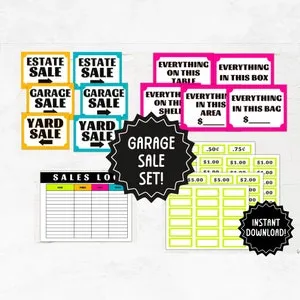
Photo: suburban garage sale driveway folding tables items price stickers morning, via i.etsystatic.com
There's a moment every garage sale host knows. It's around 10 a.m., the third hour, when a stranger holds up your college textbook — the one with your marginalia in it, your underlines, a phone number from a person you no longer speak to — and asks, "Will you take fifty cents?"
And you have to decide, right there, in your driveway, what your memories are worth.
Most of us say yes. Not because fifty cents is a fair price, but because something in us has already started letting go, and the stranger is just finishing the job.
The Garage Sale Is America's Unofficial Release Ceremony
We don't tend to think of yard sales as spiritual events. We think of them as a way to fund a vacation or clear out the garage before the HOA sends a letter. But consider what's actually happening on an American driveway any given Saturday morning: a person gathers everything they no longer need, arranges it in public view, assigns it a modest value, and allows strangers to carry it away, piece by piece, until the table is bare.
That's not a liquidation. That's a ritual. Tibetan monks build intricate sand designs over days and then dismantle them deliberately to demonstrate that nothing lasts. Your grandmother, pricing a bread machine at $5, was participating in the same tradition — she just used masking tape instead of colored sand.
The garage sale has a beginning, a middle, and a clean ending. It's temporary by design. By sundown, the folding tables are back in the basement and the driveway is just a driveway again. There's something almost radical about that in a culture that treats storage units as a growth industry. Americans currently rent billions of dollars' worth of self-storage space, much of it filled with things we're not ready to release. The garage sale is the opposite impulse: don't store it, move it along.
Pricing Is Where the Real Work Happens
Here's what nobody tells you before your first sale: the sticker is a spiritual decision.
Price something too high and you've just relocated the object from your garage to your conscience — you'll lug it back inside at noon, defeated. Price it right — meaning low, honestly low — and it walks away before you have time to renegotiate with yourself.
A few principles I learned the hard way:
- The $1 rule of liberation. Anything you feel genuinely neutral about gets a dollar. Not $3. Not "best offer." A dollar says I want this gone, and buyers can read that energy from the curb.
- The hesitation tax. If you catch yourself hesitating over a price — "maybe this is worth $20?" — that's a signal. Either it belongs at a consignment shop, or you're not ready to sell it. Both answers are fine. But don't price it at $8 and hope. Ambivalence is the most expensive sticker in the pile.
- Bundle to unburden. "Everything in this box, $2." Boxes are wonderful because they make decisions in bulk. Nobody agonizes over a single T-shirt when it's part of a five-dollar heap.
The psychology here runs both directions. Buyers at American garage sales aren't really shopping — they're treasure hunting, and a low price is part of the magic. A $1 lamp is a find. A $15 lamp is a negotiation. Your job isn't to maximize revenue; it's to maximize departures.
The Stubborn Box
Every sale has one. The item you've priced, re-priced, and re-positioned three times, and still nobody touches it. The fondue set. The treadmill desk. The framed print of ducks.
I've started treating these as the main event. If everything sold easily, the sale would just be commerce. The stubborn item is where the practice gets honest. You have two options: carry it back inside (attachment, round two) or let it go to the first person who'll take it, even free, even the guy who arrives at 11:55 a.m. looking for scrap metal.
A seller I met in Ohio — mid-sale, apron pockets full of ones — told me she keeps a "free box" out from the start, and fills it with whatever she can't bear to price. "It's easier to give away something I love," she said, "than to sell something I love for a dollar." She'd thought about this. Most people out on their driveways at 7 a.m. have thought about this more than they admit.
By Sundown
Here's how the day ends, if you do it right: the tables are lighter, the unsold boxes go straight from the driveway to the donation drop-off — do not bring them back inside, this is critical — and you're standing in a slightly emptier house holding cash that barely covers a nice dinner.
And somehow, that's the point. You didn't do it for the money. You did it to practice the one skill nobody teaches: releasing things without ceremony, without drama, without a eulogy. Just a sticker, a stranger, a transaction, and open space where the bread machine used to be.
The monks sweep their sand away to remember that even beautiful things are temporary. We do it with card tables and quarters. Same lesson, different continent.
Next time you drive past a hand-lettered GARAGE SALE sign, know what you're really looking at: someone's release ceremony, in progress. Maybe pull over. Maybe buy the ducks.