What a $3 Doily Taught Me About Letting Go: A Treasure Hunt Through America's Flea Markets
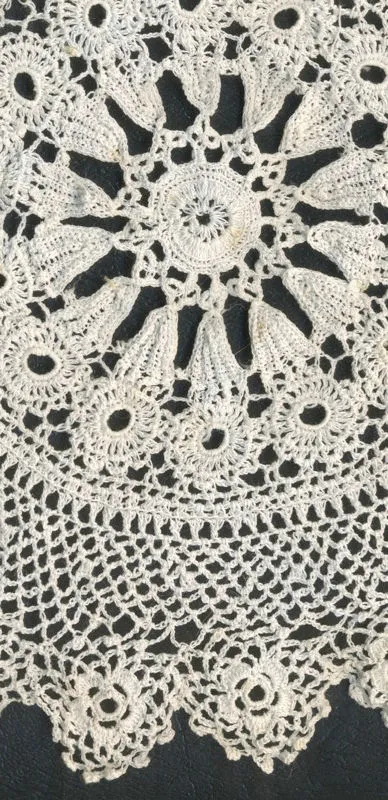
Photo: Elaine with Grey Cats from Mountain View, CA, USA (also User:Judielaine), CC BY-SA 2.0, via Wikimedia Commons
The doily cost three dollars. Hand-crocheted, ivory, roughly the size of a dinner plate, and stitched in rings that bloomed outward like ripples in a pond. The woman selling it at a church rummage sale in Dayton told me her grandmother made it in 1958, "back when people had time." She said it like an apology. I bought it like a relic.
That was the start of a three-week odyssey through America's secondhand economy — flea markets, estate sales, antique malls, one barn sale in rural Ohio where a rooster chased me for a quarter mile. My mission was simple, or so I thought: find the circles.
America Has Always Collected the Round
Once you start looking, you can't stop. The cast iron skillet, seasoned black and smooth as a river stone, spinning gently on a vendor's folding table. Wagon wheels stacked against a barn wall, spokes radiating from a hub like a diagram of the sun. Mid-century wall clocks, their faces a perfect twelve-part mandala — hours instead of petals.
Crocheted doilies. Vinyl records. Enamel roasting pans. Pie tins, hubcaps, corn cob holders arranged in concentric rings in a Tupperware bin. Even the estate sale itself follows the form: shoppers orbiting a dining room table, moving clockwise around the good china, drawn into the center where the jewelry sits.
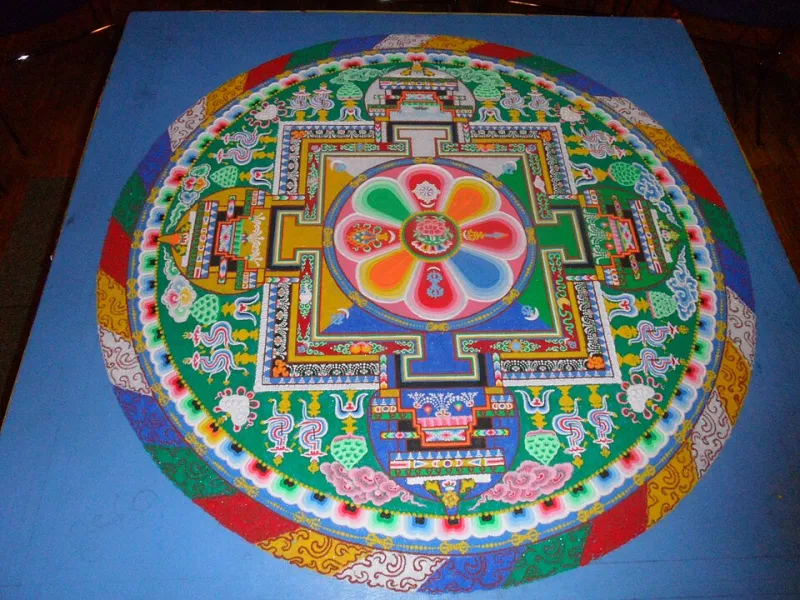
In Tibetan tradition, monks spend days laying down colored sand in intricate circular patterns, only to sweep it away when it's finished — a lesson in impermanence. Standing in a stranger's garage in Fort Wayne, holding a wagon wheel whose original owner died decades ago, I felt the same lesson land differently. Everything circles around. Nothing stays. The objects outlive their purpose, then outlive their people, then end up in a cardboard flat marked "$1 EACH."
The Estate Sale as Memento Mori (With Good Parking)
Estate sales get a bad rap as morbid. And sure, there's something quietly sobering about walking through a home where every object has been priced with a sticker gun. But there's also something oddly peaceful about it.
The professional organizers who run these sales talk about their work in almost meditative terms. "We're not liquidating a house," one told me over the din of a Saturday morning crowd. "We're helping things find their next person." She said she can tell which items will sell by noon and which will linger. The circles, she said, always go fast. "Bowls, clocks, round mirrors. People are drawn to them. They just don't know why."
Maybe we do know why. The circle is the oldest symbol humans have — older than writing, older than the wheel. Standing at a sale table in an antique mall outside Indianapolis, I watched a young couple deliberate over a hand-thrown pottery bowl, its rings visible in the glaze where the maker's fingers had pressed outward on a spinning wheel. They didn't buy it. Twenty minutes later, an older man did, holding it up to the light and nodding like he'd been introduced to someone.
A Shopper's Guide to Circular Serenity
If you want to hunt circles yourself — and you should, because it turns bargain hunting into something closer to a walking meditation — here's what I learned:
Go early, go slow. The serious pickers arrive at dawn and move fast. Let them. Your goal isn't the haul; it's the looking. Wander the aisles like you'd walk a labyrinth: no destination, just the loop.
Know your circles. Cast iron (check for cracks, not rust — rust is fixable). Wagon wheels (check for dry rot in the spokes). Doilies (handmade ones have slight irregularities; that's the point). Clocks (ask if the mechanism works, or accept it as pure form). Vintage Pyrex mixing bowls in nested sizes are basically a mandala set.
Talk to the sellers. Every round object has a story, and the story is the real treasure. The skillet that camped every summer at Lake Michigan. The clock that hung in a barbershop for forty years. You're not buying an object; you're becoming the next custodian of it.
Buy less than you want. This is the hard one. The impulse at a flea market is acquisition. But the sand mandala teaches the opposite: make it beautiful, then release it. Take photos of the circles you leave behind. Let them keep circling to someone else.
What We Pass Along
On my last day, I went back to the church sale in Dayton, mostly on a whim. The doily seller was packing up. I told her the doily was hanging above my desk now, and that I looked at it while I worked.
She smiled and pulled something from a tote bag: a small round hand mirror, its back embroidered with flowers gone soft with age. "Her mother made the back," she said. "Take it. It should keep going."
I didn't argue. Some circles are meant to be completed. And somewhere out there, in a garage or an antique mall or a card table at the end of a driveway, the next circle is waiting — patient as only objects can be, holding its shape while everything around it changes hands.