Sixty Minutes of Track and Quiet: The Hidden Meditation Room on America's Trains and Buses
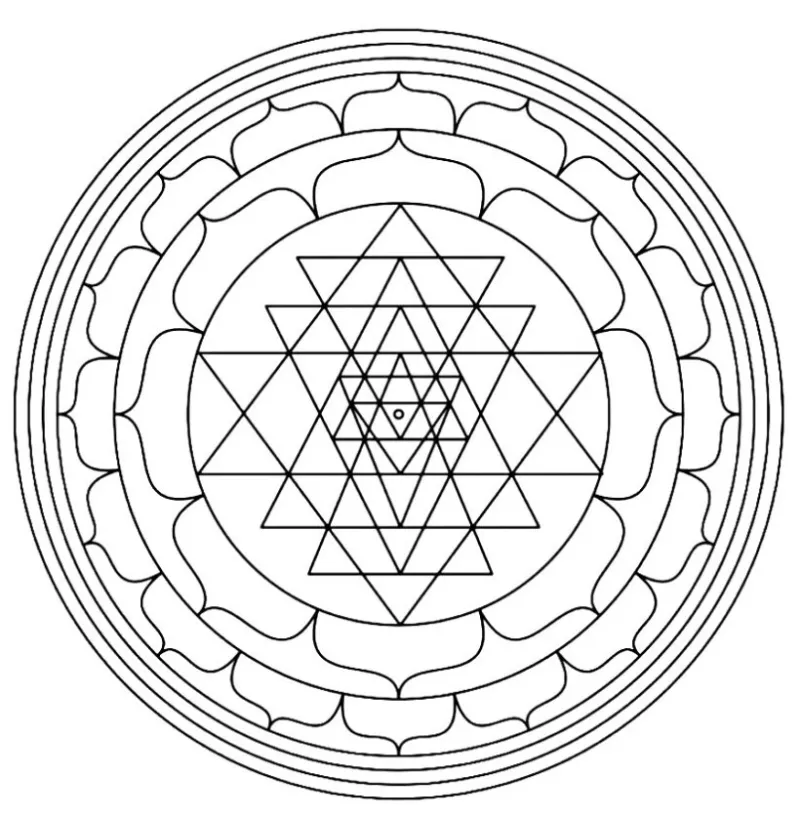
Photo: Mandalasheets, CC0, via Wikimedia Commons
At 6:47 on a Tuesday morning, on a Metra car rolling into downtown Chicago, Dana Whitfield is doing something that would have looked odd five years ago. She's coloring. On her phone, with one thumb, she's filling in the fourth ring of a mandala — petals, then dots, then a row of tiny triangles — while the suburbs blur past the window.
"I used to spend this hour on Twitter," she says, "and I'd arrive at the office already angry about something I read. Now I arrive and I genuinely cannot remember what I was mad about last week."
Whitfield is part of a quiet but measurable migration. Coloring and mandala-drawing apps have climbed the wellness charts, and if you look around any American commuter rail, subway, or bus these days, you'll spot them: heads tilted slightly down, thumbs moving in slow, deliberate arcs. Not scrolling. Circling.
The Apps Behind the Trend
The ecosystem is bigger than most people realize. Apps like Colorfy, Recolor, and Mandala Color by Number have collectively been downloaded tens of millions of times, and a newer wave — including mandala-specific drawing tools like Mandala Maker and symmetry-based sketch apps — lets users build patterns from scratch rather than fill in pre-made designs.
The appeal, according to the developers, is frictionlessness. A coloring app needs no setup, no supplies, no clean-up. It lives in the same pocket as the apps engineered to steal your attention, which is exactly the point. As one Recolor community moderator put it in a forum post that went semi-viral: "It's the only app on my phone that gives time back."
Many of these apps now lean into the commute explicitly — offline modes, one-thumb interfaces, sessions designed around 20-to-40-minute windows. The average train ride in, it turns out, is almost exactly the length of a completed mandala.
What Repetition Does to a Racing Brain
The neuroscience here is less mystical than it sounds. Repetitive, patterned activity — whether it's coloring a printed mandala or tracing one on glass — occupies just enough cognitive bandwidth to crowd out rumination. Researchers sometimes call this "soft fascination": the mind is engaged, but not taxed, which is precisely the state where the default mode network stops generating its anxious highlight reel.
A frequently cited 2005 study from Nancy Curry and Martha Kateri at Maryhurst and the University of Louisville found that coloring mandalas reduced anxiety more effectively than free-form coloring — the structure matters. The circle gives the anxious brain a container. There's an obvious next move, always. Nothing to decide, nothing to doomscroll.
Dr. Ellen Braun, a Boston-based clinical psychologist who recommends pattern work to several of her patients, puts it plainly: "The commute is a transition space. You're leaving one identity and entering another. Most people fill that gap with input — news, email, outrage. A mandala fills it with rhythm instead. You show up at your desk having already settled your nervous system."
The Commute as America's Underused Mindfulness Window
Here's the uncomfortable math. The average American commuter spends somewhere near an hour a day in transit — roughly 250 hours a year. We've long framed that as lost time, time to be optimized with podcasts, email triage, or a second screen. The entire productivity-industrial complex treats the commute as a problem to be solved.
But there's another way to see it: it's the only block of the day when nobody can schedule a meeting with you. The train doesn't have Slack. The bus doesn't need you to approve a request. For twenty, forty, sixty minutes, you are legitimately, structurally unreachable — a condition so rare in modern American life that it borders on luxury.
Framed that way, the commuter coloring a mandala isn't killing time. She's reclaiming the last genuinely unclaimed space in her day, and filling it with something that lowers her pulse instead of spiking it.
Not Everyone's Sold — and That's Fine
Purists will note, correctly, that a coloring app isn't a cushion-and-incense meditation practice, and that a phone is a phone — one tap away from the feed. Some mindfulness teachers argue the real move is a pocket sketchbook and a pencil, no screen involved.
Fair. But accessibility is its own virtue. The person who would never download a meditation timer, never attend a class, never sit still on a cushion, will absolutely fill in a mandala on the Red Line. If the circle is the doorway, let it be whatever door people will actually walk through.
The 6:15 pulls into the station. Dana Whitfield saves her mandala — unfinished, one ring short — and pockets her phone. "I finish it tomorrow," she says. "That's the other thing I like. It'll still be there."
Somewhere in that sentence is the whole pitch: for once, something on the phone that waits for you.