Sweep It All Away: What a Sand Mandala and a Navy SEAL Have in Common
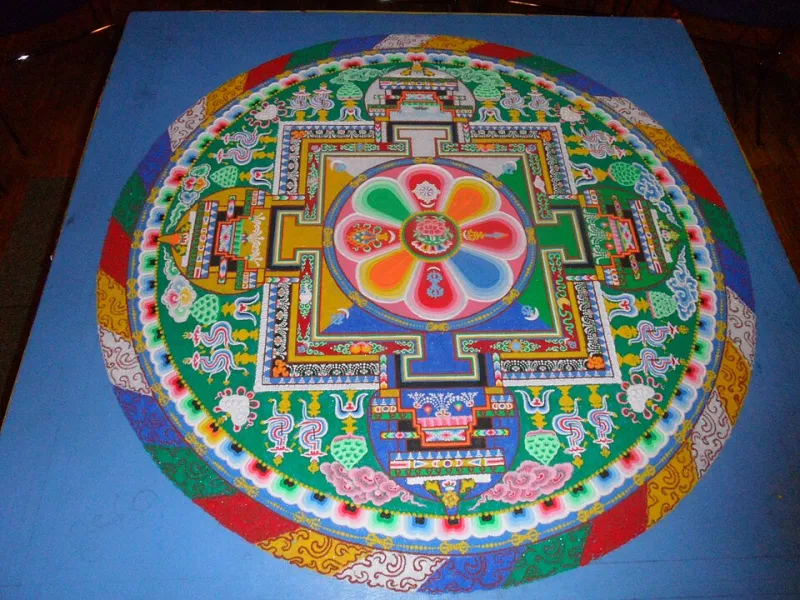
Photo: He Gerzee, CC BY-SA 3.0, via Wikimedia Commons
There's a moment at every sand mandala dissolution ceremony that catches newcomers off guard. After days of painstaking work — monks bent over a table, funnels of colored sand, millions of grains forming an intricate cosmic diagram — someone takes a brush and destroys it. All of it. The sand gets swept together in a swirl of turquoise and crimson, spooned into an urn, and carried to flowing water.
The crowd, usually, goes quiet. Sometimes someone gasps.
"That first gasp is the teaching," Dana Whitfield told me. She's organized touring sand mandala events at museums, universities, and community centers across the American Southwest for over a decade. "People have watched the monks work all week. They've fallen in love with it. And then the monks smile — they're genuinely happy — and sweep it away. You watch someone realize, in real time, that they were attached to something that was never meant to last."
The Oldest Lesson in the Newest Packaging
Here's what struck me while reporting this piece: the language coming out of American performance culture right now sounds, at times, remarkably like the monastery.
Elite athletes talk about "playing like the score doesn't exist." Writing programs teach you to kill your darlings. Silicon Valley celebrates the pivot and mourns the sunk cost. Navy SEAL training — perhaps the most revered crucible in American self-improvement — is built around a concept that sounds suspiciously Buddhist: don't let your identity fuse with outcomes you can't control.
JMarcus Reed, a resilience coach in San Diego who works with veterans, first responders, and — increasingly — burned-out tech workers, sees the overlap constantly.
"The monks practice impermanence at the scale of sand. My guys practice it at the scale of a mission that changes halfway through," Reed says. "Different vocabulary, same muscle. The ability to hold something tightly and release it cleanly. Most people can do one or the other. Very few can do both."
Detachment Gets a Bad Rap
In American culture, letting go often reads as not caring. Reed pushes back hard on that.
"Detachment in the SEAL world isn't apathy. It's the opposite. You care so much about the mission that you refuse to let your ego get in its way," he told me. "Same with the monks. They're not careless with that sand. Nobody on earth cares more about that mandala than the person sweeping it into the river. The point is that caring and clinging are different things."
Whitfield has watched the distinction land on audiences of all ages. At one library event, a teenager asked a monk why they couldn't just keep the mandala — put it under glass, preserve it forever.
"The monk answered through the translator, and I've never forgotten it: 'If we kept it, it would become a thing you own. When we release it, it becomes something you received.'"
The American Translation Problem
Of course, there's a risk when ancient practice meets hustle culture. Strip impermanence of its spiritual context and you get something uglier: burnout dressed up as enlightenment. Move fast and break things becomes a philosophy of breaking everything, including yourself.
"The monks don't destroy the mandala because nothing matters," Whitfield says. "They destroy it because everything matters — every grain was placed with full attention. The dissolution isn't the opposite of the devotion. It's the final act of it."
Reed makes a similar point about high performance. The teams that survive brutal conditions aren't the ones that don't care; they're the ones that can care completely about a process while staying loose about the results.
"You want to know the real skill?" he says. "Making something beautiful, giving it everything, and being okay when the tide takes it. That's not resignation. That's freedom."
Try a Five-Minute Mandala
You don't need a visiting delegation of monks or a BUD/S instructor to practice any of this. Whitfield suggests a version anyone can do at a kitchen table:
- Pour a thin layer of sand, salt, or sugar onto a dark plate or tray.
- Spend five minutes drawing a pattern with your fingertip — anything, imperfect is fine.
- When you finish, look at it. Really look.
- Then stir it up and pour it out.
"Do it once a week and I promise something will shift," she says. "You learn what it feels like to finish something. To love it a little. To let it go. And then to start again without dread."
In a culture that teaches us to optimize, hoard, and hold on — to bodies, to jobs, to versions of ourselves that stopped serving us years ago — there might be nothing more radical than sweeping your best work into the river and smiling while you do it.
The monks have known it for centuries. The SEALs figured it out in their own way. The rest of us can start with a plate of salt.