Rose Windows, Prize Wheels, and the Pentagon: A Field Guide to America's Hidden Mandalas
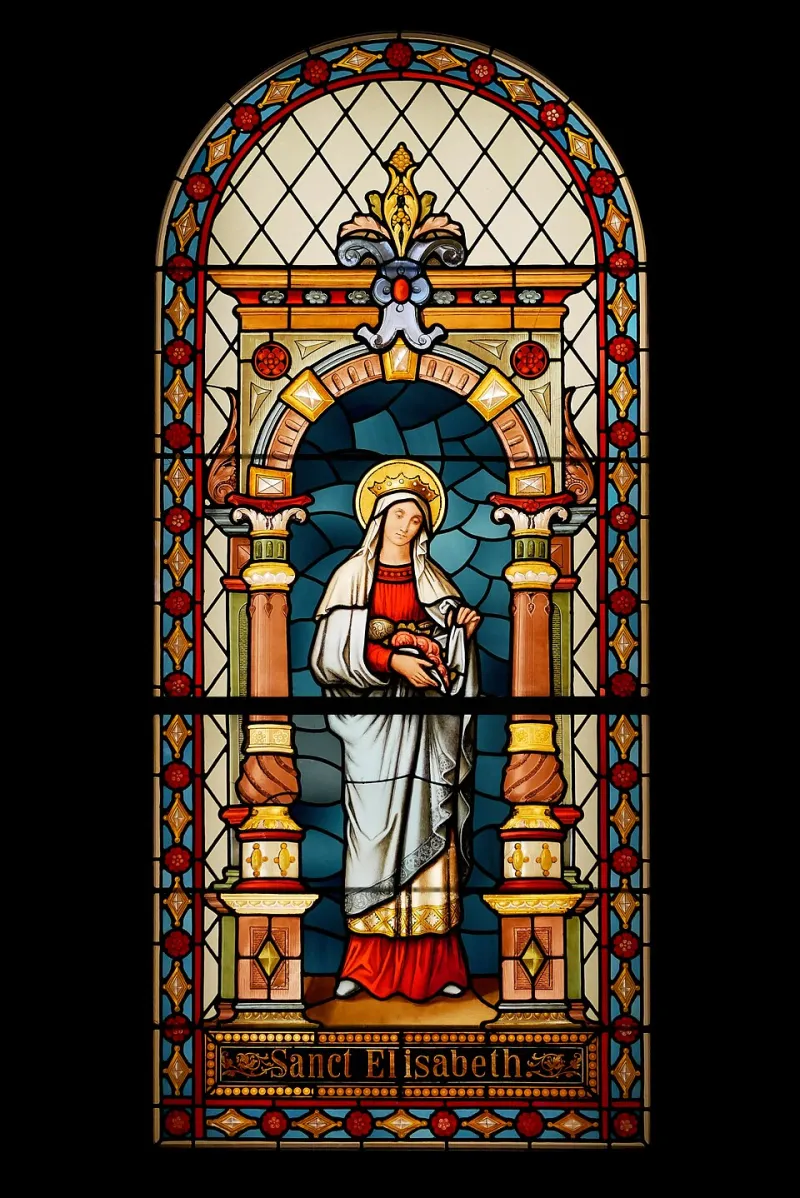
Photo: Petar Milošević, CC BY-SA 4.0, via Wikimedia Commons
Here's a game you can play on any road trip: every time you spot a radial design — anything arranged around a center point like spokes on a wheel — you get a point. Play it honestly and you'll lose count before lunch.
The mandala isn't just a Himalayan art form. It's a human instinct. Something about organizing the world around a still center shows up in nearly every culture, including the ones that built the strip mall you parked at this morning. Below: seven American mandalas you've probably strolled right past.
1. The Rose Windows of New England
Walk into almost any Gothic Revival church from Boston to Baltimore and look up — way up. The rose window, that stone-wheel of stained glass radiating from a central eye, is medieval Europe's mandala export. For worshippers who couldn't read, the window was the text: God at the center, creation radiating outward. Sit in a pew for ten minutes with the afternoon sun behind the glass and try not to feel something.
2. Navajo Sandpaintings
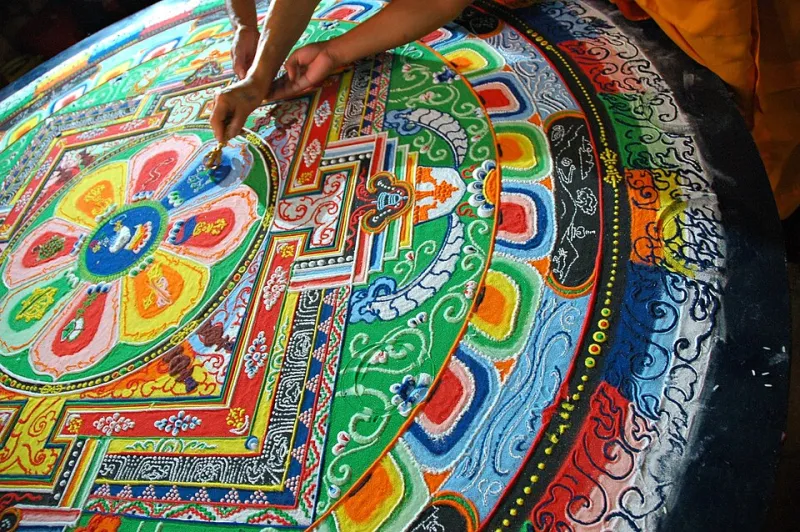
In Diné (Navajo) healing ceremonies, a hataałii creates intricate colored-sand compositions — often highly symmetrical and radial — as part of a ritual meant to restore the patient to harmony. Like Tibetan sand mandalas, they're impermanent by design. Important note: these are sacred ceremonies, not tourist attractions, so appreciate them through museums and respected cultural institutions rather than crashing a ceremony with your phone out.
3. Amish Hex Signs, Pennsylvania
Drive through Lancaster County and you'll see painted wooden discs mounted on barn gables — the famous "hex signs." Folklorists still argue about their meaning: decoration, blessing, protection, or just really good barn branding. Whatever the truth, the geometry is pure mandala: compass-drawn rosettes, distelfinks, and hearts radiating from a bullseye.
4. The Chuck E. Cheese Prize Wheel
Stay with me. A spinning prize wheel is a mandala with a ball bearing in it — a circle divided into radial wedges around a fixed center, radiating pure eight-year-old anticipation. It's proof that the form is so baked into us that even a pizza arcade uses it to make randomness feel meaningful.
5. The Pentagon (Yes, That One)
From the ground it's an office building. From the air, it's one of the largest radial floor plans on Earth: five concentric ring corridors around a five-acre central courtyard, nicknamed "the epicenter." Designed in a mad dash in 1941, its geometry is famously walkable — you can get anywhere on the ring roads in about seven minutes. A mandala you can commute inside of.
6. Quilts on the Barn Circuit
The barn quilt trails that have spread across the Midwest and Appalachia — Ohio, Kentucky, Iowa — paint giant geometric quilt squares on barn siding. Many traditional patterns (the Mariner's Compass, the Dresden Plate) are textbook radial symmetry, born from a craft tradition where stitching a circle was an act of patience and prayer.
7. The Medicine Wheel
Across the northern Plains, Indigenous peoples built stone arrangements — a central cairn with spokes radiating to an outer ring — some centuries old. These medicine wheels align with solstice sunrises and hold deep ceremonial meaning. Like the sandpaintings, they deserve reverence, not selfies: visit public sites like the one in Wyoming's Bighorn Mountains with respect, and learn from Native-led sources.
Slow Down and Look Around
What do all seven have in common? None of them were built to be rushed past. The rose window took years of glasswork. The medicine wheel took generations of meaning. Even the prize wheel is engineered to make you watch.
So here's the challenge: this week, find one circle in your town. A courthouse rotunda floor. A quilt on a porch fence. The manhole covers in older cities are often gorgeous radial castings, for crying out loud. Stand in front of it for a full minute — sixty seconds, that's all — and notice what changes.
The mandalas were always there. The center-finding, as always, is up to you.