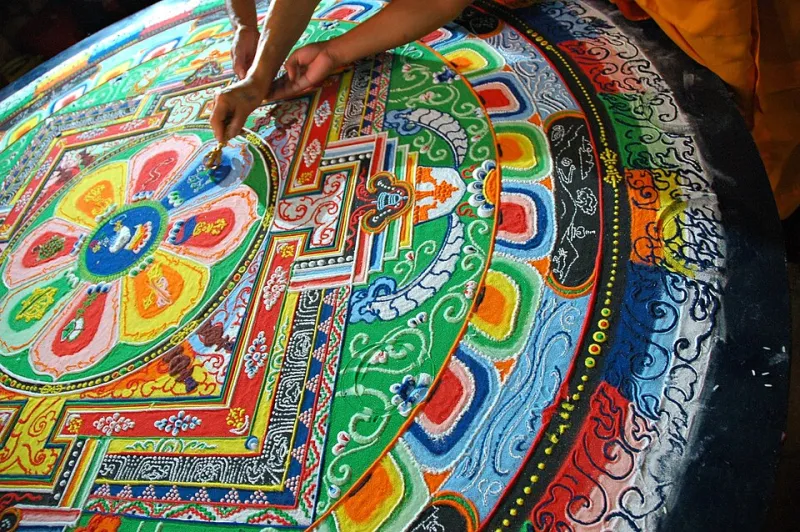
From Temple Walls to Target Aisles: What We Lose (and Gain) When Mandalas Go Mainstream

Photo: Jack Lane, Public domain, via Wikimedia Commons
Walk into almost any big-box store in America and you'll find them: mandala coloring books stacked between Sudoku collections and 'Calm the F*ck Down' journals. The same circular patterns once painstakingly created by Tibetan monks with colored sand — patterns that could take days or weeks to complete and were ritually destroyed upon completion — now sit on an endcap next to the gel pens, marked down 30%.
Depending on who you ask, this is either a beautiful thing or a small tragedy.
A Long Road From Sacred to Shelf
Mandalas have deep roots across multiple traditions. In Tibetan Buddhism, sand mandalas are devotional acts — meditations on impermanence, since the finished piece is ceremonially swept away. Hindu traditions use yantras and circular diagrams as tools for contemplation. Indigenous cultures across the Americas built circular symbols into art and architecture long before the word 'mandala' (Sanskrit for 'circle') entered the English lexicon.
Then Carl Jung happened. The Swiss psychologist saw mandalas as windows into the psyche and encouraged his patients to draw them, transplanting the form from religious practice into pop psychology. From there, the slide toward the mainstream was mostly a matter of time. The adult coloring book boom of the mid-2010s — when titles like 'Secret Garden' sold millions of copies and coloring parties became a real social activity — put mandalas squarely in the American consumer imagination. By 2015, adult coloring books were topping Amazon's bestseller lists, and mandalas were their undisputed star pattern.
Today, the mandala is everywhere: phone cases, yoga leggings, tattoos, dorm-room tapestries, and yes, the craft aisle at Target.
The Purist's Complaint
The critique writes itself. When a symbol of impermanence and devotion becomes a $9.99 paperback, something gets flattened. Mindfulness teachers I've spoken with over the years tend to land somewhere on a spectrum of concern. At the sharp end: the worry that Western consumer culture has a habit of extracting the aesthetic of a practice while discarding its substance — yoga without philosophy, meditation without ethics, mandalas without meaning. The mandala becomes 'boho décor,' a vibe rather than a vehicle.
There's also a real question of cultural respect. Sacred designs carry specific meanings in the traditions that created them. Slapping a sand mandala on a coffee mug without context can read as casual at best, disrespectful at worst. Artists from those traditions have every right to be wary of watching their heritage become a seasonal print pattern.
These critiques aren't wrong. But they're also not the whole story.
The Case for the Craft Aisle
Here's the uncomfortable counterpoint: most Americans were never going to encounter mandalas any other way.
For every person who gatekeeps the practice, there's someone whose first experience of genuine stillness came from a $12 coloring book and a pack of colored pencils bought on a whim. I've heard versions of this story dozens of times — the overwhelmed parent, the burned-out nurse, the guy recovering from surgery who found that twenty minutes of filling in petals quieted his anxiety in a way nothing else had. Nobody handed them a dharma talk. They just colored.
And here's the thing: the coloring book is a doorway, not a destination. Plenty of people who start by filling in printed patterns eventually pick up a compass, draw their own circles, and discover the deeper practice of making mandalas from scratch — the version where the repetition becomes genuinely meditative. The commercial product can be the on-ramp. Democratizing access to a calming practice isn't the same as cheapening it, even if the packaging is mass-market.
There's also a middle path that more teachers are embracing: context. A coloring book that includes a paragraph about where mandalas come from does more good than a purity test nobody passes. Respect and accessibility aren't actually opposites.
So, Dilution or Democratization?
Honestly? Both. And the ratio depends on what we do with it.
Commercialization flattens when we treat the mandala as pure decoration — another aesthetic to consume and discard. It opens doors when it leads someone toward an actual practice: drawing, coloring with intention, sitting with a circle long enough to notice their own breathing slow down.
The Tibetan monks who sweep away their sand mandalas aren't mourning the loss of the object. The point was never the artifact — it's the attention, the impermanence, the act itself. In a strange way, that philosophy gives mass-produced mandalas a pass. The coloring book will end up in a donation bin eventually. What matters is whether, for a few minutes, it helped someone find their center.
At Mandala Net, we'd rather have a million people coloring imperfect mandalas at their kitchen tables than a thousand purists keeping the circle locked away. The circle has always been an invitation. It doesn't check credentials at the door.
Color outside it if you want. Just keep showing up to it.