Your Hands Know How to Meditate: A Five-Minute Circle Practice for the Restless Mind
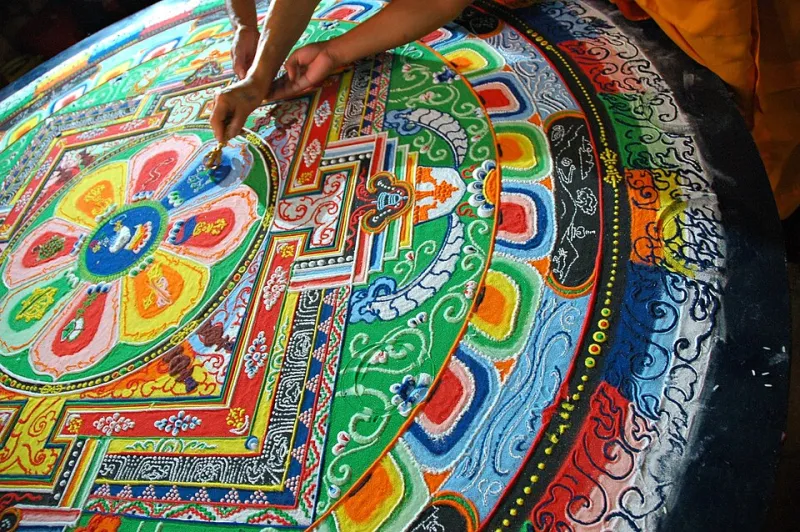
Photo: Wonderlane, CC BY 2.0, via Wikimedia Commons
Let's be honest about meditation for a second. You've downloaded the apps. You've tried the breathing exercises. You've sat cross-legged on your bedroom floor at 6 a.m., counting breaths, while your brain ran through your inbox, your grocery list, and that weird thing you said in a meeting three years ago.
If that sounds familiar, here's some good news: mindfulness doesn't require sitting still. In fact, for a lot of us — especially the fidgeters, the overthinkers, the people whose minds treat silence as an invitation to panic — moving your hands works better than emptying your head.
That's where the mandala comes in.
Why Drawing Beats Sitting (For Some of Us)
A mandala, at its simplest, is a circular design built from repeated patterns radiating out from a center point. You don't need artistic talent. You don't need special supplies. You need a piece of paper, a pen, and five minutes.
The reason this works has everything to do with how your nervous system responds to repetition. Research on flow states and expressive arts therapies suggests that rhythmic, repetitive hand movements — think knitting, doodling, drawing — can lower cortisol levels and activate the parasympathetic nervous system, the one responsible for that 'okay, we're safe' feeling. It's the same mechanism behind why people pace when they're on stressful phone calls or why fidget tools took off in offices.
When you're drawing a pattern around a circle, your attention has somewhere to land. The repetitive motion occupies the part of your brain that would otherwise be spinning anxious narratives. Psychologists sometimes call this 'soft fascination' — your focus is gently held without being gripped. It's meditation, but with a training wheels for your wandering mind.
And unlike seated meditation, there's no failure state. Nobody can draw a mandala 'wrong.' The circle accepts whatever your pen gives it.
The Five-Minute Morning Mandala
Here's the whole practice. Set a timer for five minutes — actually set it, so you're not checking the clock.
Minute 1: Draw the frame. Put your pen in the middle of the page. Draw a small circle. Around it, draw two or three larger circles, like ripples in a pond. Freehand is fine — wobbly circles are part of the charm, and honestly, part of the practice.
Minute 2: Start from the center. Fill the innermost circle with something simple: dots, a flower shape, three curved lines. One pattern only. Don't plan it. Let the pen decide.
Minutes 3 and 4: Build outward. Move to the next ring and repeat a pattern around it — petals, scallops, triangles, little arcs. Then the next ring, a new pattern. Repetition is the point. When your mind drifts (it will), the pattern is your anchor. Notice the drift, come back to the next petal.
Minute 5: Close the circle. Finish your outermost ring, or just stop wherever the timer ends. Look at what you made for a few seconds. Take one slow breath. That's it. That's the whole ritual.
Making It Stick in a Real American Schedule
The hardest part isn't the drawing — it's protecting five minutes in a morning that's already a hostage negotiation between the snooze button and the school run.
A few tricks that actually work:
- Stack it onto something you already do. Draw while your coffee brews. Draw before you open your laptop. Attach the habit to an existing anchor so you don't have to 'find' time.
- Keep the supplies visible. A pen and a small notepad on the kitchen counter beat a beautiful journal buried in a drawer. Friction is the enemy of habits.
- Do it at your desk. If your mornings are chaos, this doubles as a midday reset. Five minutes between Zoom calls with a pen and a sticky note-sized circle can clear your head better than a third coffee.
- Don't chase pretty. Some mornings your mandala will look like a scribbled pizza. Doesn't matter. The benefit lives in the process, not the product. If you want to post it, great — but the practice pays off whether or not anyone sees it.
Start Your Own Center
At Mandala Net, we think of the circle as a metaphor as much as an art form: every day has a center, and you get to choose what you build around it. A five-minute morning mandala won't fix your inbox or your commute. But it gives you a small, reliable pocket of calm before the noise starts — one ring, one pattern, one breath at a time.
Tomorrow morning, before the phone, before the news: one circle. See how it feels.
Your hands already know how to meditate. Now you've got five minutes to let them.