Push the Cart, Breathe the Loop: A Walking Meditation Hidden in the Parking Lot
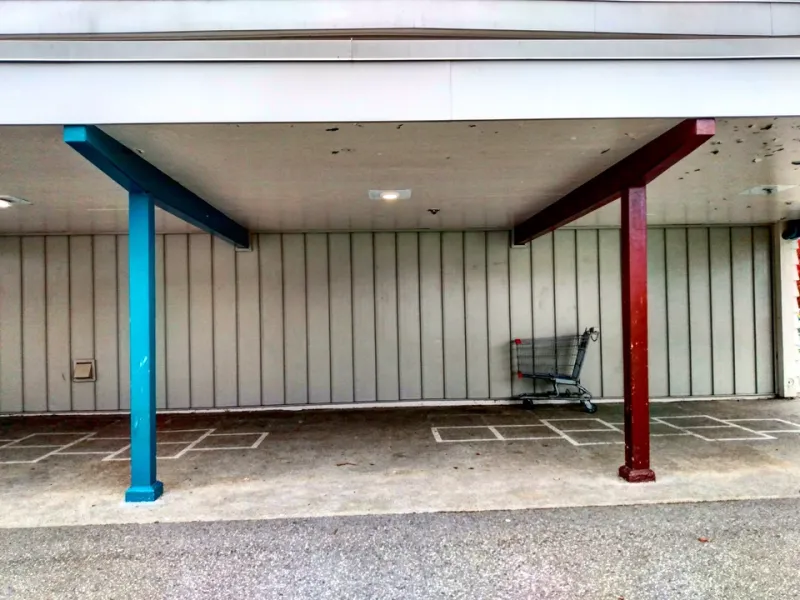
Photo: Whythealgarve, CC0, via Wikimedia Commons
There's a moment that happens in every Costco, Walmart, and Home Depot parking lot in America. You've just spent an hour inside buying a rotisserie chicken and a sixty-pack of something you didn't need, and now you're sitting in your car, engine off, watching a family of five walk slowly toward the cart return like it's a religious procession. You could leave. But you don't. You wait. And in that waiting — that strange, tense, deeply American limbo — is where I found something unexpected.
I found the parking lot is already a mandala. We're all just too annoyed to notice.
The Most Anxious Square Footage in America
Ask anyone what they hate about a big-box run and they won't say the crowds inside. They'll say the lot. The circling. The brake-tap standoff over a spot that opened up 40 feet closer to the door. We treat the parking lot like a competition, and we treat the walk from our car like a tax we're trying to dodge.
But here's the thing about circling a big-box lot: you're literally moving in a ring around a center point. The store is the still center. You, your car, and a hundred other stressed-out shoppers are tracing its outer bands, over and over. If you drew the flight paths of a Saturday afternoon at a Costco on a map, you'd get something that looks a lot like the sand mandalas monks spend days pouring grain by grain.
The difference is intention. The monks know what they're drawing. We don't.
Your Cart Is Already a Mala Bead
In traditional meditation, a mala is a string of beads — you move one bead per breath, and the repetition gives your mind something simple to hold. Now, I'm not going to tell you your shopping cart is a sacred object. It has a wheel that pulls left and a handle that some previous shopper used as a cutting board. But functionally? Pushing a cart is a rhythm. Handle to hands, one step, two steps, breath in, breath out. The cart rolls ahead of you at exactly walking speed. It sets the pace. You just have to let it.
That's the reframe: stop hunting for the spot. Start walking the loop. The lap you were already doing becomes the practice.
A Five-Minute Lot Practice
Next big-box run, try this before you even reach the doors:
1. Park far on purpose. Pick a spot in the back row — the one everyone else is circling to avoid. This single choice dissolves the competition. You've already won by surrendering.
2. Grip the handle, feel the rhythm. Hands on the cart, shoulders down. Let the cart set your pace instead of hurrying it. One stride per breath is a good ratio; whatever feels natural is the right one.
3. Count the loop, not the spots. As you walk, quietly count your breaths up to ten, then start over — one lap of your attention around the ring. When you catch yourself scanning for closer spots or rehearsing your shopping list, that's not failure. That's just the mind doing laps of its own. Come back to the handle.
4. Let the cart return be your bell. When you pass someone wrangling a runaway cart back into the corral, treat it like a chime in a meditation hall. A small mental note: there goes another bead.
5. Stop before the doors. Take one full breath at the threshold. Then walk in.
That's it. No incense, no cushion, no app subscription. Just you, a cart, and a ring of asphalt you've walked a hundred times without ever actually being there for it.
Why This Works When Sitting Doesn't
A lot of people — maybe most people — can't meditate because they can't sit still. The parking lot practice sidesteps that entirely. Walking meditation is one of the oldest forms of the practice precisely because movement gives a restless mind a job. Your body is busy, so the mind quiets down to watch.
And there's a deeper lesson hiding in the asphalt, one that fits the whole idea of drawing a circle just to let it go. The parking lot spot you fight for? You'll leave it in an hour. The proximity you gained by circling twice? It saved you maybe ninety seconds. The monks who sweep away a finished sand mandala aren't being wasteful — they're demonstrating that the thing we cling to was never the point. The circling was.
So the next time you're idling in a lot the size of a small county, waiting for a minivan to buckle in three kids, take the far spot. Push the cart. Breathe the loop.
You might walk into the store calmer than you walked out of it.