Barefoot in the Spray: What My Grandpa's Old Sprinkler Knows About Starting Over
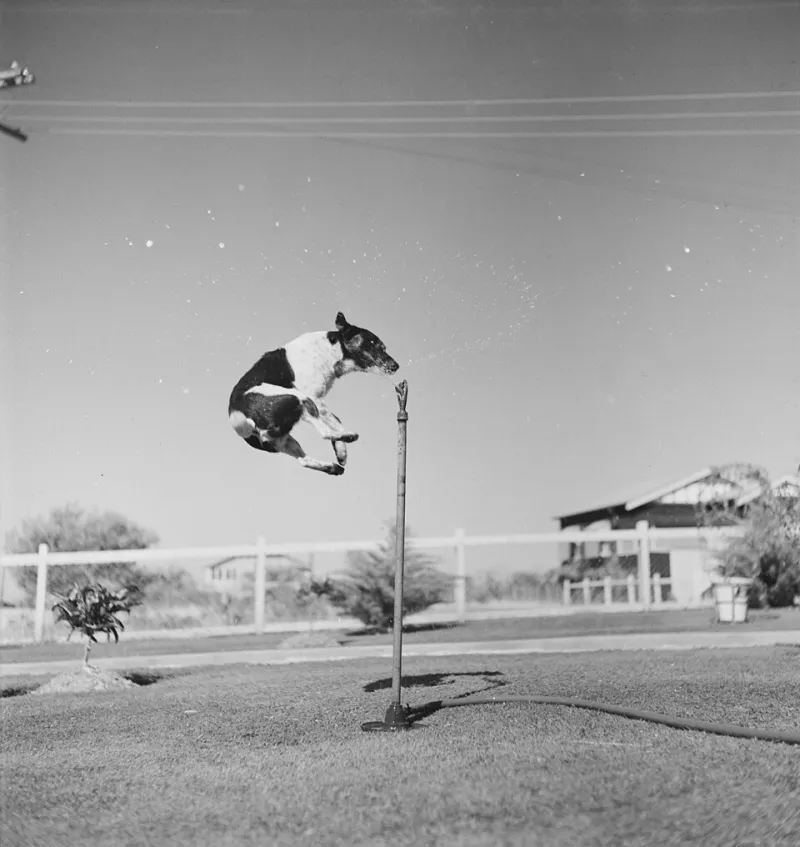
Photo: State Library of Queensland, No restrictions, via Wikimedia Commons
There's a green plastic sprinkler in my garage that belonged to my grandfather. It's dented, the paint's chipped, and it wobbles a little when the water pressure runs high. Every July, I hook it up to the same rusty spigot he used, and every July, it does the exact same thing it did in 1987: it spins in a slow, determined circle, soaking the same patch of St. Augustine grass, over and over, without a single complaint.
I didn't used to think much about it. Then one evening, after a day that had gone sideways in every possible way, I found myself standing in the yard barefoot, hose running, just watching the thing turn. And somewhere around the fourth rotation, something in my chest unclenched.
The Slowest Machine in America
We live surrounded by devices engineered for speed. Our phones refresh in milliseconds. Our microwaves count down in seconds. Even our coffee makers brag about how fast they can push hot water through grounds. The sprinkler is the opposite of all that. It's a machine with one job and no deadline.
Watch it long enough and you start to notice the geometry. Each pass of water is an arc, and each arc overlaps the last one just slightly. There are no gaps in the coverage because the sprinkler doesn't skip ahead. It doesn't get bored with the far corner of the yard and rush to finish. It simply returns, and returns, and returns.
If you've spent any time around mandala art, you already know where this is going. A mandala isn't drawn in a straight line. It's built from repetition — the same shape repeated around a center point until the repetition itself becomes the beauty. The sprinkler is drawing one, pass by pass, in water. It just evaporates when it's done, which might be the most Buddhist thing a lawn appliance has ever done.
A Five-Minute Backyard Ritual
You don't need my grandfather's sprinkler to try this. Any rotating sprinkler will do. Here's the practice I've landed on, refined over a couple of summers of very scientific grass-watering research:
Step one: Take your shoes off. This is non-negotiable. Something about grass underfoot signals to your nervous system that you're off the clock. If your HOA has opinions about bare feet, that's between you and the board.
Step two: Turn the water on and step back. Don't check your phone. Don't adjust the angle. Your only job for the next five minutes is to watch.
Step three: Follow the spray from edge to center. Pick a spot where the water lands at the far edge of its reach. Track it as it sweeps around, spiraling inward toward the sprinkler itself. When it reaches the center, start over at the edge. The point isn't to see anything mystical — it's to give your eyes one simple, looping task.
Step four: Notice when your mind wanders, then come back. It will wander. Somewhere around rotation three, you'll suddenly remember you need to email your accountant. That's fine. The sprinkler will still be turning when you get back. It always is.
Step five: End with the sound. Before you shut the water off, close your eyes for one full rotation and just listen. That soft, rhythmic chk-chk-chk of the sprinkler head is the sound of something doing its work without hurry.
Repetition Gets a Bad Rap
I think part of why we resist mindfulness practices is that we've been taught repetition is the enemy. Same commute, same dishes, same weeds coming back every June. We treat looping as failure — a sign we're stuck.
But the sprinkler has no interest in novelty. It repeats because repetition is how coverage happens. Repetition is how mandalas happen. Repetition is, frankly, how anything worth doing gets done. The monks who pour sand into intricate circular designs spend days making the same marks, and when the wind takes it all away, they start again without grief. The sprinkler starts again every time you twist the spigot, and it never once sighs about it.
There's a freedom in that. Your meditation practice doesn't have to be profound. Your evening walk doesn't need a new route. Watching the same arc of water land in the same grass for the ten thousandth time can be the most interesting thing happening in your evening, if you let it be.
The Yard That Waters Itself
These days, that dented green sprinkler is my favorite piece of meditation equipment, and it cost my grandfather probably four dollars in 1970s money. When the day has been loud, I head out at dusk, kick off my sandals, and turn the water on. Five rotations. Sometimes six.
The circle always finishes. The yard always gets watered. And I always come back inside a little more willing to start my own next rotation — dishes, emails, bedtime routine, whatever the evening holds. The sprinkler doesn't mind that it will do it all again tomorrow.
Neither, increasingly, do I.