The Dryer Ate My To-Do List: A Laundromat Meditation on Circles and Letting Go
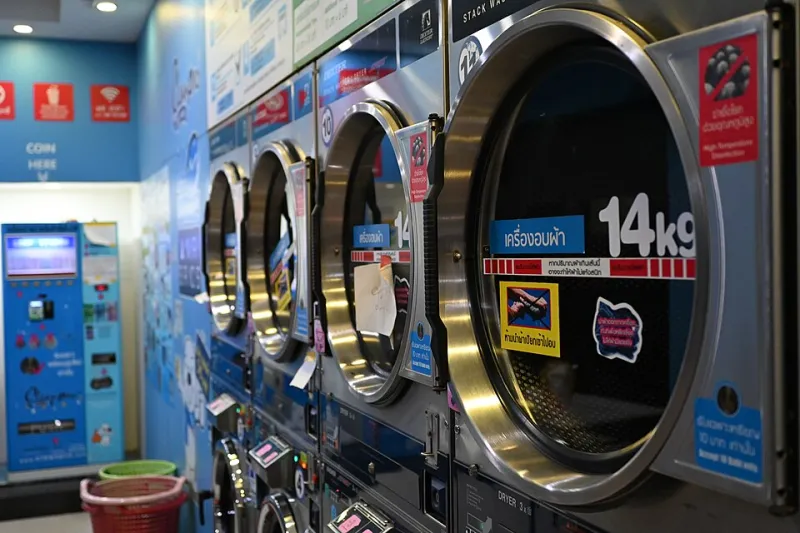
Photo: PattayaPatrol, CC BY-SA 4.0, via Wikimedia Commons
The Chapel of Fluorescent Light
There is a particular kind of quiet inside a neighborhood coin-op. Not silence—laundromats are never truly silent—but a steady, low-grade hum that makes conversation feel optional. The fluorescent lights buzz. A cart rattles across linoleum. Somewhere near the back, a dryer thumps along like a slow heartbeat.
I went in on a Tuesday with a basket of towels and a mental to-do list long enough to wallpaper the place. I left with damp socks, a folded receipt, and an unexpected sense of calm. It wasn’t the detergent. It was the circles.
Mandalas are usually pictured as intricate paintings or sand designs, but the word simply points to a center and the patterns that gather around it. A laundromat is full of centers. The drum of the washer. The porthole window. The folding table where strangers arrange their lives into neat rectangles. Even the floor tiles, if you look long enough, start to behave like a grid of little mandalas.
What the Drum Knows
A front-loading washer does not care about your schedule. It fills, agitates, drains, spins, and repeats. The machine is not trying to be profound. It is simply doing what circular motion does: returning to the same position with slightly different contents each time.
That is the first lesson. Repetition is not stagnation. The laundry goes around and around, but it is not the same load it was ten minutes ago. Water moves through fabric. Dirt lifts away. The cycle changes the thing being cycled.
Dryers are even better teachers. They tumble without much drama. Every few minutes you hear a zipper ping against metal or a button tap the glass. The sound is not a problem to solve. It is just the soundtrack of something moving through a process. If you are waiting for the buzzer, the wait feels long. If you are listening to the tumble, the wait becomes part of the practice.
This is where the mandala idea comes in handy. A mandala asks you to keep your attention near the center while the outer rings do their thing. In a laundromat, the center can be your breath. The outer rings are the quarters, the detergent caps, the missing sock, the guy folding twelve identical T-shirts. You do not have to fix any of it. You just keep returning.
A Five-Minute Spin-Cycle Practice
When the washer hits its final spin, most of us stand there like we are waiting for a microwave to finish. Instead, try this:
- Plant your feet. Feel the floor beneath you. Notice the vibration of the machine through your shoes.
- Find the circle. Watch the clothes turn through the porthole if you can see them. If not, listen to the rhythm of the spin.
- Breathe in for four counts. Breathe out for six. Let the out-breath be as long as the spin feels loud.
- Name the motion. Silently say, “Turning.” Then, “Changing.” Then, “Letting go.” Repeat as needed.
- Stop when the machine stops. No bonus points for lingering. The practice ends when the cycle ends.
Five minutes is enough. You are not trying to achieve anything. You are just giving your attention a center to come back to. The spin cycle is short. Your to-do list will still be there. But you might meet it with a little more room around the edges.
Turning Chores into Ritual
A ritual does not require candles or a special cushion. It requires attention and a beginning. Laundry day already has both: you arrive, you sort, you load, you wait, you fold, you leave.
The trick is to stop treating the waiting as dead time. Bring a book, but also bring a willingness to look up every few pages. Notice the colors moving behind the glass. Notice how the room has its own weather—warm near the dryers, cool near the door. Notice the people. A laundromat is one of the last honest cross-sections of a neighborhood. Everyone is there because something needs cleaning.
You can also make the folding table a small mandala of order. Start in the middle with one item. Work outward. Match corners. Smooth seams. This is not about being tidy for its own sake. It is about giving your hands a simple, circular task while your mind settles. The pile gets smaller. The breath gets slower. The circle closes.
The Fold at the End
Impermanence is easy to accept in theory and harder in practice. But a laundromat makes it concrete. The clean clothes will get dirty again. The quarters will run out. The missing sock may never return. The dryer will buzz, and someone else will claim the machine.
That is not a depressing thought. It is a freeing one. The cycle keeps going. You do not have to hold on to every moment of it. You just have to show up, put in your load, and pay attention while it turns.
I left the coin-op that Tuesday with warm towels and a quieter head. The to-do list was still long. The difference was that I could see it for what it was: a set of circles, one after another, each one asking me to return to the center and begin again.